
The Wood Lane taxi bomb put five men in the dock. The Panorama revenge theory never did
A Real IRA bomb in a red taxi exploded outside BBC Television Centre on 4 March 2001. Five men were convicted at the Old Bailey in 2003. A suggestion that the attack was revenge for a Panorama film was never stated in court.
Published
Watch the TEA ROOM NEWS episode
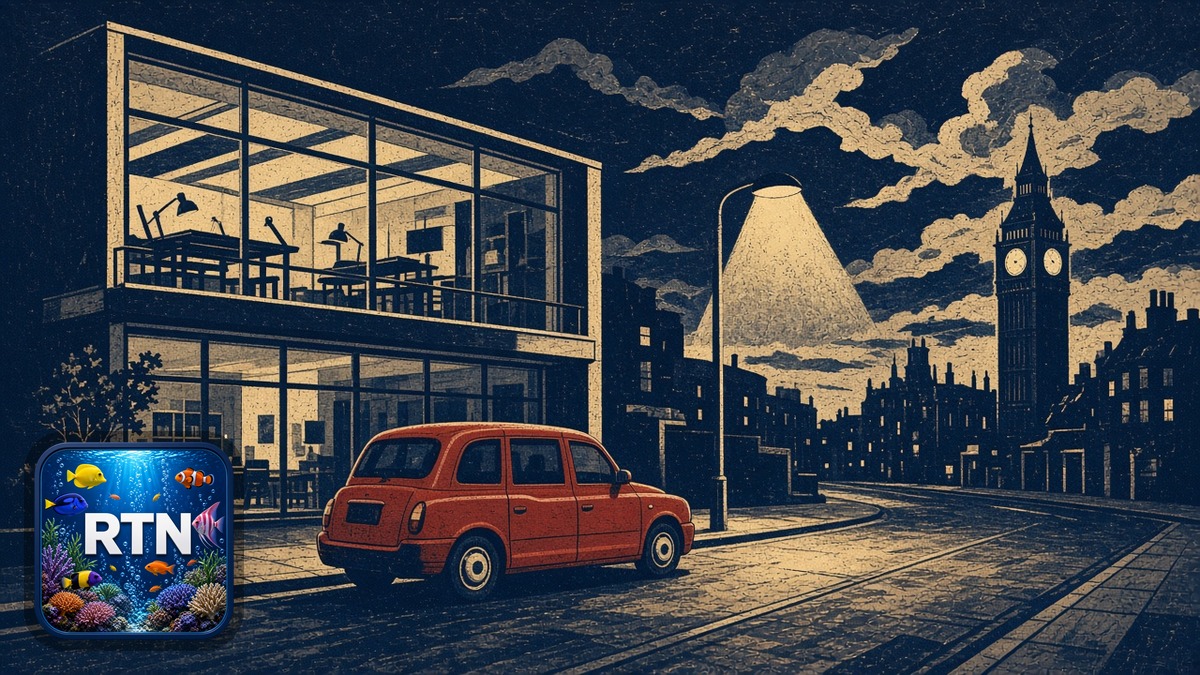
Just after midnight on 4 March 2001, a bomb in a red taxi exploded outside BBC Television Centre on Wood Lane, in west London, contemporaneous police and news accounts of the blast record. The Real IRA had given coded warnings to a hospital and a charity, using the same codeword it had used for other bombs in its 2001 campaign, those official and journalistic accounts state. Police were attempting a controlled explosion when the device went off, at about 00:27, the same reports say. Windows in the BBC building were blown out, damage reports at the time recorded. An Underground worker was cut near the eye, casualty accounts state. There were no deaths.
It was the fourth Real IRA attack in London in nine months, and it came after the same organisation’s bombing of Omagh in 1998, which had killed 29 people, the established record of that campaign and of Omagh shows. The Wood Lane device was aimed at a symbolic target rather than a packed high street, but it was not a harmless spectacle. The Irish Times later reported that it was a miracle no pedestrians were killed, in its 9 April 2003 account of the subsequent trial. The campaign did not stop at the BBC. In August 2001 a bomb exploded in Ealing, and in November another went off in Birmingham, contemporaneous reporting of those attacks records.
Two years later the criminal case produced convictions. At the Old Bailey in April 2003, five men were convicted of conspiracy over the Real IRA’s English campaign, including the Wood Lane bomb: Noel Maguire, Robert Hulme, Aiden Hulme, James McCormack and John Hannan, court reporting of the verdicts states. Hannan was 17 at the time of the offences, that coverage records. He and McCormack admitted the charges, the same reports say. Aiden Hulme denied them and was convicted. Sentences handed down by Judge Richard Gibbs ran from 16 to 22 years, sentencing reports, including the Irish Times of 10 April 2003 as cited in Tony Adams’s research dossier, state.
The prosecution case, as reported at the time, was a logistics trail rather than a confession of motive. The Irish Times, in its account of the verdicts on 9 April 2003, described a diesel-washing cover in Yorkshire and Maguire’s thumbprints on notes used to pay for the cab. Not every count stuck. Maguire was acquitted of possessing timers and detonators, that Irish Times report states. Hulme and Maguire were cleared of possessing a grenade and a revolver, the same report records. The conspiracy convictions stood.
What the court did not find is as important as what it did. In the hours after the blast, Professor Paul Wilkinson suggested, among several possible reasons for the choice of target, that the attack might have been revenge for the BBC’s Panorama film Who Bombed Omagh?, a suggestion reported the same day by RTÉ, on 4 March 2001. It was never stated in court, and the Real IRA did not claim it, the research pack’s review of the public record finds. The dossier marks “revenge for Panorama” as unproven. It should stay that way. A possible motive aired on the day of an attack is not a finding.
The men convicted in 2003 did not all serve their sentences in Britain to the last day. The Hulme brothers and James McCormack were later imprisoned in Portlaoise, in the Republic, and were freed in July 2014 after legal challenges in Dublin, the Irish Examiner reported, as cited in the source list and dossier. Those releases, and the legal arguments that secured them, are part of the aftermath. They do not unpick the Old Bailey verdicts. Five men were convicted of conspiracy, the 2003 court record shows. The taxi bomb at Television Centre was part of the campaign the jury was asked to consider.
Twenty-five years after the blast, the official story is plainer than the speculation that first surrounded it. A Real IRA bomb in a taxi damaged the BBC’s main centre and injured a transport worker, the 2001 incident record shows. Five men were convicted at the Old Bailey in 2003, the verdicts show. A theory about Panorama remains a theory, as RTÉ’s day-of-attack report and the later trial record, taken together, make clear. The record that can be stood up is the one returned by a jury, and the damage that was done on a Sunday night in Wood Lane.
Sources
- The Irish Times, Three convicted of UK bomb plot, 9 April 2003, Source as cited. Accessed 18 November 2026.
- RTÉ, 4 March 2001, Wilkinson on possible motives, Source as cited. Accessed 18 November 2026.
- Tony Adams research dossier: BBC Television Centre taxi bomb 2001, Source as cited. Accessed 18 November 2026.
- Tony Adams, Tea Room News research dossiers, scripts and source lists, 18 November 2026, Tony Adams research pack. Accessed 18 November 2026.
Sources link to external sites. Their content is the responsibility of their publishers.